Los Angeles earthquake magnitude 5.0 struck just off the coast of Manhattan Beach on Saturday morning, November 28, 2026, rattling millions of people across Southern California and setting off dozens of aftershocks. The quake hit at 9:30 a.m. Pacific time, about 3.7 miles west-southwest of Manhattan Beach, at a depth of roughly 7.6 miles, according to the U.S. Geological Survey (USGS). It was the strongest earthquake to shake the Los Angeles area since 2014, and despite the jolt, officials reported no injuries and no major damage.
The shaking was felt far beyond the South Bay. The USGS estimated that about 15.8 million people felt the quake, with reports coming in from Santa Monica, Pasadena, Ventura County, and across Los Angeles County. In the beach towns closest to the epicenter, people ran out of shops, car alarms went off in parking lots, and pictures fell from walls. More than 26,000 people filed felt reports with the USGS in the hours after the quake.
What happened on Saturday morning
The earthquake struck at 9:30 a.m. PT (12:30 p.m. ET) on Saturday, November 28, just offshore in Santa Monica Bay. The USGS first measured the quake at magnitude 5.2, then revised it down to 4.7, before settling on a magnitude of 5.0. The figures remain preliminary, which means they could still change slightly as seismologists complete their review.
The epicenter was only about 20 miles southwest of downtown Los Angeles, in one of the most densely populated parts of Southern California. Manhattan Beach itself is a coastal city of about 35,000 people, and millions more live within a short drive of the epicenter. That is why a quake of this size, which might pass almost unnoticed in a remote area, was felt by so many people.
The shaking was strongest near the epicenter, in Manhattan Beach and El Segundo, and at Los Angeles International Airport (LAX), according to the USGS. Shaking was also reported at the Rose Bowl in Pasadena, where the press box rattled hours before the USC-UCLA rivalry game kicked off. The timing could hardly have been more dramatic: the game would decide whether No. 9 UCLA clinched a spot in the Big Ten Championship Game.
The quake arrived during a busy Thanksgiving holiday weekend, one already shaped by wild weather. Thanksgiving storms had already forced the first-ever postponement of the Macy’s Thanksgiving Day Parade, and shoppers were out in force for Black Friday deals. The earthquake added a jolt, literally, to a holiday weekend that was already making headlines.
Aftershocks kept coming all morning
The 5.0 quake was not a one-off jolt. It was followed by dozens of aftershocks, and the largest of them arrived a little over two hours later. At 11:41 a.m. PT, a magnitude 4.5 aftershock struck near the same spot off Manhattan Beach. The Los Angeles Fire Department had initially called it a preliminary 4.6, but the USGS later listed it at 4.5.
The aftershock sequence was steady. Within minutes of the main quake, a magnitude 3.0 tremor was recorded near Hermosa Beach, followed by a 2.5 near Manhattan Beach. A magnitude 3.5 aftershock hit at 10:01 a.m., a 3.8 at 10:30 a.m., another 3.8 at 11:03 a.m., and a 4.1 at 2:08 p.m. By midday, about 40 aftershocks had been counted, and the USGS catalog showed 31 aftershocks of magnitude 2 or larger within about 19 miles of the epicenter.
The USGS had estimated a 30 percent chance of an aftershock of magnitude 4.0 or greater, and that is exactly what happened. Seismologists say aftershocks can continue for days or even weeks after a quake of this size, and the California Geological Survey expects more shaking in the area over the coming days to weeks. The fault that caused the quake was not immediately known, though the USGS fault database places the epicenter about 2.1 miles southwest of the Compton thrust fault.
No injuries and no major damage reported
For a quake felt by nearly 16 million people, the outcome was remarkably calm. The Los Angeles Fire Department went into “earthquake mode” after the initial quake, mobilizing personnel from all 106 neighborhood fire stations to survey the city by land, air, and sea, covering 470 square miles. Shortly before 11 a.m., the department said the survey was complete and no significant infrastructure damage or injuries had been found.
After the 11:41 a.m. aftershock, the fire department went into earthquake mode a second time, once again sweeping the city. That inspection also found no structural damage or injuries. Los Angeles Mayor Karen Bass said there were no reports of major damage to critical infrastructure and that the fire department was assessing potential impacts across the city.
There was some damage, but it was minor. Glass shattered inside a terminal at Los Angeles International Airport, and some residents in the South Bay and South Los Angeles reported pictures falling from walls. Airport officials said airfield inspections were completed with no issues observed and flight operations were normal. The city of Manhattan Beach closed the Manhattan Beach Pier out of an abundance of caution because of the earthquake activity, and urged residents to stay away from damaged buildings and downed power lines and to secure heavy objects that could fall.
The National Tsunami Warning Center said there was no tsunami danger from either of the larger quakes. Social media users also shared footage of flames and smoke over the Chevron refinery in El Segundo; Chevron said the facility was experiencing a “contingency flaring incident,” according to USA Today.
Why this quake was felt so widely
A magnitude 5.0 earthquake is moderate by California standards, and it usually causes little damage. What made this one so widely felt was where it happened: just offshore from one of the largest metropolitan areas in the United States, at a depth shallow enough for the shaking to reach the surface across a huge area.
It was the largest earthquake in the Los Angeles area since the magnitude 5.1 La Habra earthquake in March 2014, and one of the most powerful near the city since a magnitude 5.4 quake shook Chino Hills in 2008. But experts said Saturday’s quake was deeper than the 2014 La Habra quake, which was much closer to the surface, and that helped limit the damage.
“That gives you a little bit farther distance for those waves to travel up to the surface and cause shaking,” Elizabeth Cochran, an observational seismologist at the USGS, said at a news briefing. Dr. Lucy Jones, a veteran USGS researcher, said the shaking was also mitigated because the quake occurred offshore. USGS seismologist Clara Yoon put it simply: the earthquakes were not very big, “but they happened close to a large population.”
The USGS ShakeAlert early warning system was activated, and alerts were distributed over the Wireless Emergency Alert system, giving some people a few seconds of warning before the shaking arrived.
What officials say comes next
The main message from officials on Saturday was caution, not alarm. The city of Manhattan Beach urged residents to be prepared for aftershocks. The California Governor’s Office of Emergency Services said it was working with local officials to assess potential impacts. And seismologists stressed that aftershocks are a normal part of a sequence like this one.
Aftershocks are smaller earthquakes that follow the largest quake in a sequence, and they can happen weeks, months, or even years after the mainshock. The USGS issued an aftershock forecast for the coming week, and the California Geological Survey expects tremors to continue over the next days to weeks. The magnitudes reported so far remain preliminary and may be revised as more data is reviewed.
For residents, the advice is the same as after any California quake: check for damage, secure heavy objects, keep emergency supplies ready, and know what to do if the ground moves again. Drop, cover, and hold on remains the recommended action during shaking, and people should stay away from damaged buildings and downed power lines afterward.
A Thanksgiving weekend that kept shaking
The earthquake capped a Thanksgiving weekend that was already full of surprises for Southern California. The holiday storms that postponed the Macy’s parade for the first time in its history were still clearing, college football rivalry weekend was in full swing, and millions of Americans were traveling home or hunting for Black Friday deals. Then, at 9:30 on a Saturday morning, the ground moved under one of the biggest cities in the country.
In the end, Los Angeles got a scare, not a disaster. A magnitude 5.0 quake and a magnitude 4.5 aftershock, dozens of smaller tremors, shattered glass at the airport, a closed pier, and millions of startled residents — and, as of Saturday evening, no injuries and no major damage. For a city that sits on one of the most active fault networks in the world, that is a result officials will take. But the aftershocks are still coming, and the region will be watching the ground for days to come.
Frequently asked questions
How strong was the Los Angeles earthquake on November 28, 2026?
The main quake was a preliminary magnitude 5.0, striking at 9:30 a.m. PT about 3.7 miles west-southwest of Manhattan Beach, at a depth of about 7.6 miles, according to the USGS. It was the largest earthquake in the Los Angeles area since the magnitude 5.1 La Habra quake in 2014.
Was there a tsunami warning after the Los Angeles earthquake?
No. The National Tsunami Warning Center said there was no tsunami danger from either of the larger quakes on Saturday, November 28, 2026.
Was anyone hurt in the Manhattan Beach earthquake?
No injuries or major damage were reported. The Los Angeles Fire Department surveyed the city twice, after the main quake and after the 11:41 a.m. aftershock, using personnel from all 106 neighborhood fire stations, and found no significant infrastructure damage or injuries. Some glass shattered inside a terminal at LAX, and the Manhattan Beach Pier was closed as a precaution.
Will there be more aftershocks in Los Angeles?
Almost certainly. About 40 aftershocks were recorded by midday on Saturday, including a magnitude 4.5 at 11:41 a.m. The USGS had estimated a 30 percent chance of an aftershock of magnitude 4.0 or greater, and the California Geological Survey expects aftershocks to continue over the next days to weeks.
What should I do during an earthquake?
Drop, cover, and hold on: get under a sturdy table or desk, cover your head and neck, and hold on until the shaking stops. Stay away from windows, heavy furniture, and anything that could fall. After the shaking, check for injuries and damage, avoid damaged buildings and downed power lines, and be ready for aftershocks.
Sources: U.S. Geological Survey (USGS); Associated Press, November 28, 2026; CNN, November 28, 2026; USA Today, November 28, 2026; Los Angeles Fire Department; City of Manhattan Beach. Magnitudes are preliminary and may be revised as seismologists review the data.
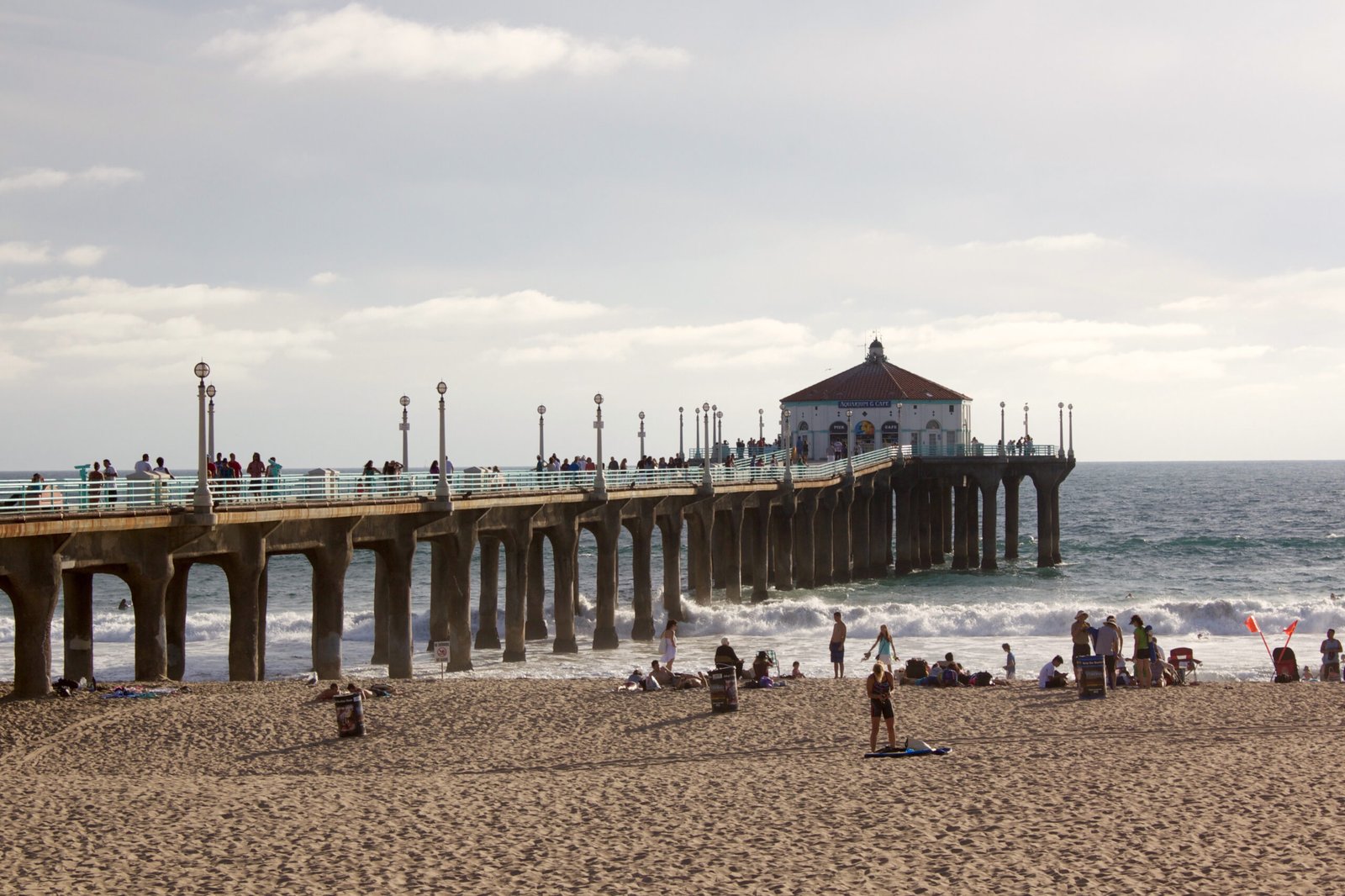
Featured photo: The Manhattan Beach Pier, by Jacob Gelman, CC BY-SA 4.0, via Wikimedia Commons.
1 thought on “Los Angeles Earthquake Magnitude 5.0 Shakes Manhattan Beach”